


3rd July 2023
If you’re at all familiar with the history of modern art, then you’ll also likely be familiar with a very popular 1980 documentary series by Robert Hughes, accompanied by a book of the same name: The Shock of the New.
The term “the shock of the new” encapsulates the idea that the introduction of innovative artistic techniques, subject matters, and approaches challenged established norms and expectations.
Both the book and series highlight the radical shifts in artistic expression and the tension between innovation and resistance to change, illustrating how the shock of encountering these new forms of art was a transformative experience for both artists and society at large.
When you’re accustomed to the idea, it’s easy to borrow the term to explain the current landscape of emerging industrial markets today, and the associated manufacturing practices developing through a purpose-driven need.
When adopting new technologies and exploring emerging industries, there is often a disruptive element involved. The introduction of automation and robotics, agritech systems, and micromobility initiatives for example, can challenge established norms, disrupt traditional industries, and require individuals and organisations to adapt to new ways of doing things.
The apprehensions and barriers which will be detailed more later, such as job displacement, regulatory challenges, and concerns about public acceptance, are all manifestations of “the shock of the new.” They represent the initial resistance or discomfort that can arise when confronted with significant technological or industry transformations.
However, it’s important to note that “the shock of the new” is not inherently negative. It encompasses the potential for innovation, progress, and positive change. The benefits (which again are detailed later), including increased efficiency, economic growth, safety improvements, and sustainability, are all outcomes that can emerge once the initial shock dissipates, and society embraces and adapts to the new technologies and industries.
This blog will home-in on several emerging sectors, used as scene setters for the challenges restricting widespread adoption, alongside the benefits that they also offer. We’ll also gain the knowledge and insights from industry experts at the forefront of each of these markets and associated technologies to try and make sense of the phenomenon.
or keep scrolling to continue reading the full article

Matthew Aldridge
igus UK
Cutting cost and complexity to encourage wider adoption of robotics & automation

Rowan Crozier
C. Brandauer & Co Ltd.
Will the EV window of opportunity close before we can take real advantage?

Scott Thompson
Niche Vehicle Network
Supply chain readiness and overcoming micromobility’s ‘chicken and egg’ situation

Emilio Loo Monardez
WMG
Rethinking agriculture at the centre of some of the world’s biggest issues
To take advantage of the opportunities new technologies and emerging markets offer, we need to first address…
When adopting new technologies and exploring new industries, there can be several barriers and apprehensions that organisations and individuals encounter. Let’s dissect some common ones:
Implementing new technologies often requires significant financial investment. Purchasing automation and robotics equipment for example, has carried with it the stigma of high costs for some time. But for those close to the technology, whilst cost can initially be a barrier, it is crucial to consider the long-term benefits, scalability, and the potential return on investment. Evaluating the overall impact on efficiency, productivity, and competitiveness is essential for making an informed decision.
Developing agritech systems, or establishing micromobility infrastructure can be deemed expensive too, which can be a barrier for smaller businesses or individuals with limited resources. Cost is particularly evident as a barrier in the agriculture sector due to how highly diverse it is. There is a wide range of crops, farming practices, and geographical variations. Developing agritech solutions that cater to these diverse needs can be complex and costly. Customisation and adaptation of technology to specific agricultural practices and local conditions can further increase the overall expenses.
Automation and robotics, for example, whether it be on the factory floor or a floor of crops, have the potential to replace human workers for certain tasks. This can lead to concerns about job losses and unemployment, particularly for workers whose skills may become obsolete. Addressing the impact on the workforce and ensuring appropriate reskilling and job transition programmes is crucial for factories.
In the agriculture sector, workforce displacement is more nuanced. Many regions around the world are experiencing labour shortages. Factors such as an aging farming population, migration from rural to urban areas, and changing labour market dynamics contribute to these challenges. In fact, the barrier is not so much displacement, but availability of workers in the first place.
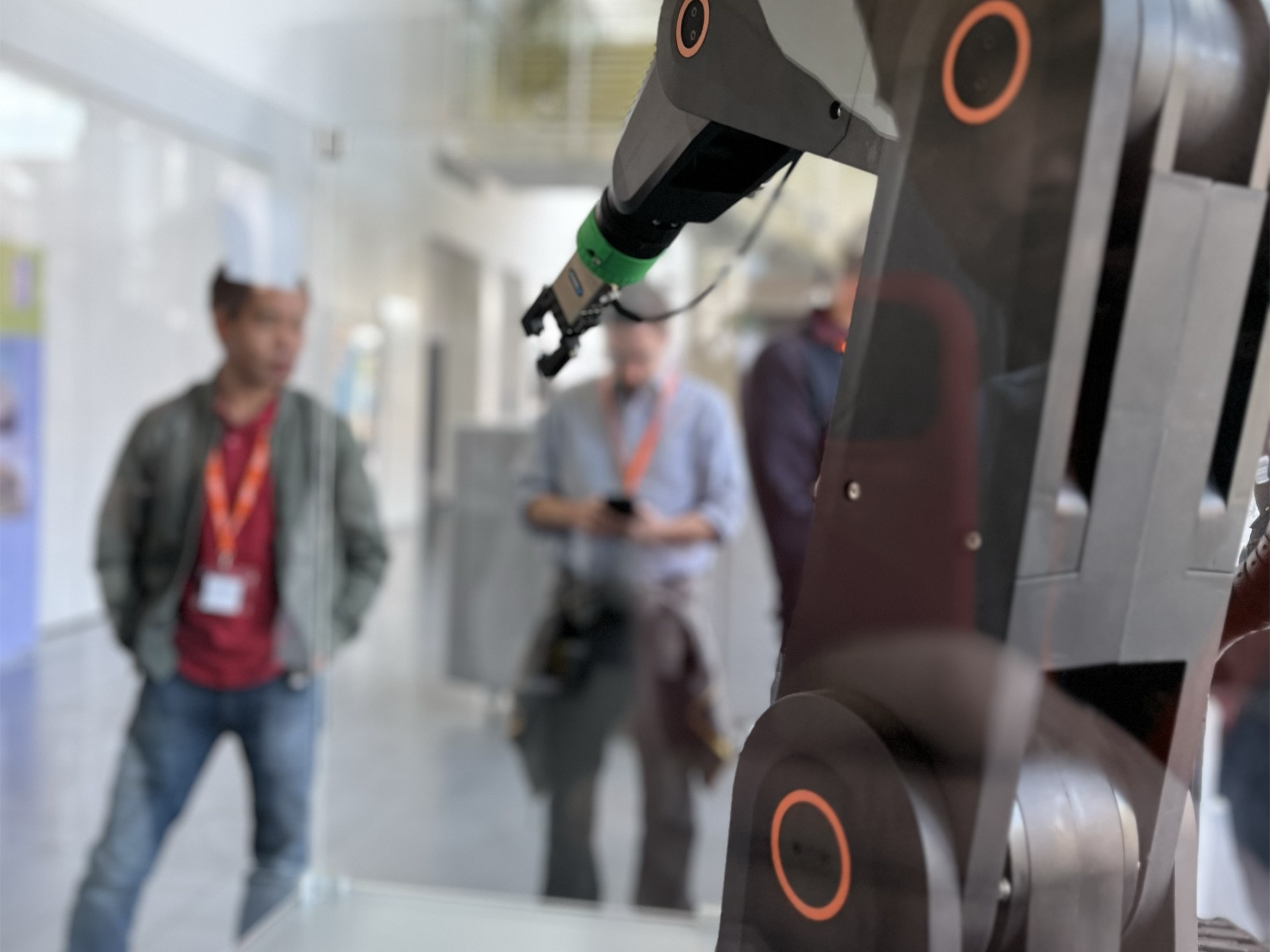
Photo: igus® robot arm, Robolink DP demonstration, RBTX event, Cranfield University
Matthew Aldridge is Managing Director at igus UK, a leading manufacturer of motion plastics, and the company behind RBTX, an online platform designed to help remove the cost and complexity barrier from the adoption of small-scale robotics and automation.
Automation operations that are most familiar to people include robots welding sections in car factories and lifting goods onto pallets. These are medium to heavy payload tasks. At the smaller end of robotics, there are many repetitive, small-scale tasks that need high accuracy, where more often than not, humans are doing the work that a small robot could do much better. Think of dispensing pipettes of fluid accurately in containers, circuit board inspection, sorting parts, pick & place on a food manufacturing conveyor, mini assembly on a workbench in a lab…
But companies often refrain from exploring small robot systems due to the perception of cost and complexity associated with medium and heavy payloads. It is easy to see why in this case, cost and complexity can be a barrier.
Those more familiar, medium payload robots can cost at least £50,000. But the whole automation work package, including the design, tooling, end effectors, safety guarding, conveyors, integration, programming, and the installation, can mean costs far beyond the initial investment in the robot. The robot is just one-third of the total cost.
Very aware of and acute to these barriers, igus introduced RBTX.com to the market, an online, self-configure platform for low-cost robotics and automation. Individuals and companies can specify, build, and – most importantly – cost their complete robotic or automation solution online. The robots are low to medium payload models, either gantry, delta, SCARA or cobot types. The control systems, end effectors, and all parts are suited for this scale of operation, keeping the cost down. A turnkey system is almost always under £30,000 and very often under £10,000 – that’s for everything, ready to go.
RBTX.com is brand agnostic; four robot manufacturers and several other component suppliers are currently on the platform, so users can mix-and-match components to get the best system. RBTX will only allow a configuration which works, and any adapter plates or ‘missing parts’ are automatically included in the bill of materials. When a system is configured online, and if the customer is serious and the system is based on an igus robot, igus in Northampton can build the very system they’ve configured and test it. But even then, there is no obligation to purchase. The platform is removing most of the risk associated with adopting this technology and gives people autonomy over the whole process, so they’re free to explore this technology at their own pace.
Supporting artwork featured throughout this article is generated by ai prompts to depict emerging markets and technologies in different modern art styles – A nod to the inspiration of Robert Hughes’ Shock of the New, along with the recent disruption and adoption of artificial intelligence technologies.


New technologies often bring about legal and regulatory challenges. There might, for instance, be a lack of clear guidelines and regulations for operating in emerging industries like micromobility. Navigating the legal landscape and ensuring compliance with existing regulations, or even waiting for the invention of new ones can be a serious barrier for organisations, delaying progress and therefore adoption.
Micromobility is the perfect industry case study for understanding why regulatory and legal challenges hinder adoption. The length of time it takes to create new legislation has become a significant barrier. There are several factors that contribute to this time-consuming process. It typically requires multiple stages, including drafting, committee reviews, public consultations, and voting procedures. Micromobility is a relatively new concept, and policymakers may not have sufficient expertise or understanding of its intricacies.
Furthermore, there’s a need to balance interests and viewpoints, and political priorities, changes in government leadership, and bureaucratic hurdles which can all impact the timeline.
Some new technologies and industries require the development of supporting infrastructure. For instance, agritech may require the establishment of reliable internet connectivity and access to electricity in rural areas. Similarly, micromobility initiatives might necessitate the creation of dedicated bike lanes or charging stations.
The electrification of vehicles is perhaps the most talked about industry in this particular topic. Not at all surprising when the government’s ban on the sale of new petrol and diesel cars comes into effect from 2030. Charging infrastructure, grid capacity and power supply are much debated but arguably the most sought-after solution is in battery technology and recycling.
EV battery technology continues to improve, but longer charging times and limited driving range compared to internal combustion engine vehicles remain challenges. Faster charging solutions and advancements in battery capacity are necessary to overcome these limitations.
Proper recycling and disposal infrastructure for EV batteries are also essential. They need to appropriately manage the growing number of retired batteries, and therefore, the need to develop efficient and environmentally friendly recycling processes is crucial to minimise waste and maximise resource utilisation.
Safe to say, insufficient infrastructure can hinder the implementation and scalability of any new technology.

Photo: Brandauer stamped, micron-precise electrical steel laminations
Rowan Crozier, CEO of Birmingham-based Brandauer has led the precision metal stamping business into the world of modern electrification and clean mobility.
Brandauer has secured several funded projects in the development of thin gauge laminates and components for use in electric motors and new technologies. The opportunity is plentiful and there is evidently a demand on the horizon that could mean opportunities for UK manufacturers in almost every discipline. But I think we need to be better prepared for it.
Brandauer’s involvement in a number of clean mobility consortiums is helping to develop the technology and the supply chain needed to support the electrification of vehicles in the UK. These projects illustrate the kind of partnerships we need a lot more of. And we need more of them fast.
Supply chain readiness is potentially the biggest challenge. The successful transition to electric vehicles will require a robust supply chain that can deliver the necessary components and materials at scale. We need to ensure a reliable supply chain for batteries, electric drivetrain and motor components, and the charging infrastructure.
This scale up challenge is huge and we’re not just talking about the electrification of cars, this same technology will be adapted and then adopted by other transport sectors too – aerospace being an obvious one. The rate at which these industries and other market territories are pushing to electrify is becoming a race against time for the distribution channel.
It could all come in a flood, but will we be capability ready, capacity ready, and supply chain ready? I ask this of the UK manufacturing community, but the same goes for the global manufacturing community too.

Adopting new technologies often requires gaining public acceptance and trust. People may be apprehensive about automation and robotics due to concerns about safety or the impact on employment. There have also been some concerns and controversies surrounding the implementation of micromobility. Issues such as pavement clutter, improper parking, and safety concerns (e.g., accidents involving riders and pedestrians) have received negative media attention. Some articles have raised questions about regulations, infrastructure requirements, and the potential impact of micromobility on existing transportation systems.
Public acceptance and trust are essential for the successful adoption of new technologies in emerging industries. Building trust requires solutions to many of the barriers above, but also transparent communication, stakeholder engagement, and a focus on addressing societal concerns and ethical considerations. By proactively addressing these factors, emerging industries can foster a favourable environment for wider adoption.

Photo: The bo M Electric Scooter completed three Niche Vehicle Network funded projects
Scott Thompson is Programme Director at Niche Vehicle Network, an independent network of UK manufacturers and specialist technology organisations, responsible for some of the sector’s most ambitious zero emission and low carbon vehicle technology projects in niche vehicle applications.
As we move towards a net zero future, set against the current challenges within our cities to address congestion, air quality and EV recharging infrastructure, it’s really exciting to see the potential that increased use of Powered Light Vehicles (PLVs) and micro mobility could offer.
Occupying less road space, being lower weight – and therefore needing less power and energy storage – combined with the ability to potentially charge from a domestic socket means they tick a number of practical boxes. While there are some fantastic examples of urban commuter and last mile delivery vehicles that are in development as well as those that are now in market, I think it’s fair to say that the supply chains and associated economics for UK manufactured PLV and micro mobility vehicles remains challenging.
While we’re starting to see some smaller size and swappable battery solutions emerging from UK suppliers, they are still heavily reliant on cell sourcing from Asia or other non-EU locations. There are also currently limited UK manufactured options for suitable vehicle controllers, motors, inverters, and other associated power electronics in the 250W – 35kW power ranges, so a lot of the high value content within these products continues to be sourced overseas.
There is of course a certain amount of ‘chicken and egg’ to tackle – vehicle manufacturers naturally want confidence that they are going to get reliable, cost-effective products, but technology developers and suppliers need a certain level of volume demand to set up the production tools and facilities which then help to drive the unit costs down.
We’re at a point where we really need industry to come together if we want to move this potential opportunity forward, taking a look at the potential collective volumes and common needs, to try and create a range of robust and economically viable UK manufactured hardware that everyone can benefit from.

Addressing any of these barriers and apprehensions often requires collaboration between industry stakeholders and expert manufacturing partners and associations, policymakers, and the public. It is crucial to have transparent discussions, implement supportive policies, and prioritise responsible and sustainable adoption of new technologies and industries. So how do we do that practically and start benefiting as a community of manufacturers and as a nation?
We start by voicing and demonstrating the true value of adopting these new technologies and accelerating their industries.
Determining whether the benefits of adopting new technologies and industries outweigh the apprehensions is of course a subjective assessment and varies depending on factors such as, the specific context and stakeholders involved. However, it is a well-backed argument to make, and it starts by displaying the true value of adoption and the benefits that these technologies and industries can bring.
Let’s summarise the benefits with our example industries as a guide.
| Automation & Robotics | Agritech | Micromobility | Electric Vehicles |
|---|---|---|---|
| Automation and robotics can streamline processes, reduce human error, and improve productivity in various sectors. | Agritech technologies can enhance crop yield, optimise resource utilisation, and contribute to sustainable farming practices. | Micromobility can offer convenient and eco-friendly transportation options, reducing congestion and emissions. | Electric vehicles offer increased energy efficiency compared to internal combustion engine vehicles. |
| Whilst concerns about job displacement exist, adopting new technologies and industries can also generate economic growth and create new job opportunities. The development, implementation, and maintenance of these technologies require skilled workers, fostering employment throughout sectors and the distribution chain. |
| Automation & Robotics | Agritech | Micromobility | Electric Vehicles |
|---|---|---|---|
| Automation and robotics can be employed in hazardous or repetitive tasks, enhancing workplace safety. | Agritech systems can monitor crops for diseases and optimise resource usage, resulting in improved yield and product quality. | Micromobility initiatives promote safer and greener transportation alternatives. | Electric vehicles include robust safety systems, such as collision avoidance and driver-assistance systems, which enhance road safety. Additionally, electric vehicles generally have fewer moving parts and require less maintenance. |
| Automation & Robotics | Agritech | Micromobility | Electric Vehicles |
|---|---|---|---|
| Automation and robotics can optimise energy consumption and reduce waste. | Agritech can promote precision farming techniques that minimise water usage and chemical applications. | Micromobility reduces reliance on fossil fuels, leading to lower emissions and a greener transportation system. | By replacing internal combustion vehicles with electric ones, we can mitigate the environmental impact of the transportation sector, improve air quality, and reduce reliance on fossil fuels. |
| Automation & Robotics | Agritech | Micromobility | Electric Vehicles |
|---|---|---|---|
| Automation & robotics can improve accessibility and convenience in several ways, from increased productivity and quality, to remote access and extended operating hours. | Agritech can provide solutions for food security by improving crop production in remote or underserved areas. | Micromobility offers flexible and affordable transportation options, particularly in congested urban areas. And it also offers individuals with certain mobility impairments increased independence and mobility. | As charging networks expand, range anxiety diminishes, making electric vehicles a practical choice for everyday transportation. |
| Adopting new technologies and exploring emerging industries fosters technological advancements. This can lead to innovations, knowledge sharing, and the development of new solutions and products that benefit society as a whole. |
What is clear is that a holistic approach is required to fully realise the benefits of these technologies and emerging markets, including the development of sustainable and renewable energy sources, the integration of smart grid technologies, and the promotion of circular economy principles for things like battery recycling and reuse.
It is essential also, to recognise and address the challenges associated with adopting new technologies and industries. This includes actively managing the impact on the workforce, ensuring privacy and security, and mitigating potential environmental and social risks. Through responsible implementation and stakeholder collaboration, it is possible to maximise the benefits while minimising the drawbacks and concerns.

Photo: The CROMBOT prototype uses AI to monitor crops to create a database to build the greenhouse of the future
Emilio Loo Monardez, Lead Engineer at Warwick Manufacturing Group (WMG) is embroiled in the thinking behind game-changing solutions in the agritech sector, putting WMG at the forefront of solving some of the world’s most immediate challenges.
Agriculture is at the centre of many of the world’s biggest issues, from hunger to climate change. The United Nations estimates that 50% more food will be needed by 2050 to feed the increasing population. ’Rethinking agriculture’ is a new concept that, much like the historical Agricultural Revolution, seeks to transform and add value into agriculture operations, and aims to address labour dependency, operational cost, environment/ecosystem performance, and energy efficiency by using the best practices of Industry 5.
WMG, University of Warwick, through its Automation Systems Group has a focus on AgriTech developments to address industry challenges and improve the UK’s agriculture sectors and planetary boundaries. AgriTech strives to meet the industry challenges in the most cost-effective and sustainable way possible and create the technology needed for the growers.
This industry is complex, dynamic and not an inert object, but living organisms that react in
an ecosystem require constant care. A collaborative vision is required in the short, medium,
and long term that includes modular technologies that can be expanded. Strategy data
analytics through the use of IoT, AI, Digital Twin, vision systems and robotics will be essential
in shaping the future by introducing new sustainable and efficient ways to produce food.
The industry will face major changes in the next five years and will need the collaboration of
plant scientist, engineers, growers, and technology developers to move towards more
complex solution such as harvesting robots. Technologies to implement must include the
business strategy of the growers’ operations translated into an efficient and meaningful use
of AI for data collection, analytics, and forecasting.
Increasing the cost-effectiveness, speed, reliability and repeatability of robotics and automation solutions will help producers reduce investment risk towards the “farming of the future” that is already coming.
For more information on working with WMG, University of Warwick, please email wmgbusiness@warwick.ac.uk

A machine builder or OEM’s strategic alignment with a multi-disciplined manufacturing partner can play a significant role in facilitating the adoption of their new technologies and products.
The traditional benefits of outsourcing can all contribute to helping emerging industries bring products to market at speed and with less risk. But the best partners offer even more value than that.
The PP+ initiative is an example of this value. It gives technology and market disruptors access to value-added resources such as scaling-up coaching, sales consultation, marketing and PR support, and introductions to academia, legislative bodies, and engineering groups.
A strategic partner with this kind of network at its disposal elicits what is at the very heart of overcoming the “shock of the new” and adopting the technologies these emerging markets can offer. And that is, collaborative innovation.
Strategic outsourcing partnerships foster collaborative innovation. By working closely with outsourcing partners, organisations can benefit from joint research and development efforts, knowledge exchange, and co-innovation. Outsourcing partners often have valuable insights into process optimisation, product improvement, and cost-effective production techniques, not to mention those value-added networks of expertise and experience.
This collaboration can drive continuous improvement, foster innovation throughout the supply chain and most importantly, enhance the technology adoption process.
With that said, let’s remind ourselves of the more traditional measures that outsourcing delivers but in relation to the adoption of new technologies:
Strategic outsourcing partnerships allow organisations to tap into the expertise of skilled engineers. When adopting new technologies, such as automation and robotics or electric vehicles, partnering with manufacturers who have experience and knowledge in those areas can accelerate the adoption process. These manufacturers bring industry-specific insights, best practices, and technical know-how.
Strategic outsourcing partners often have the necessary infrastructure, equipment, and resources to produce part or full machine builds and products more efficiently and at a lower overall cost. Outsourcing allows organisations to leverage the economies of scale and focus their resources on research, development, and sales & marketing activities related to the new technology.
Strategic outsourcing partnerships offer scalability and agility to accommodate the adoption of new technologies and particularly the peaks and troughs in demand where markets are volatile. Manufacturers with established production capabilities can quickly scale up or down. This agility allows organisations to adapt to changing market dynamics, product iterations, or technology advancements without incurring significant fixed costs or delays.
Outsourcing partnerships can expedite the time-to-market for new technologies. Specialised manufacturers often have streamlined processes, established supply chains, and efficient production capabilities. By partnering with them, organisations can leverage their expertise and resources, resulting in faster prototyping, NPI processes and production, to the full commercialisation of new technologies. This accelerated time-to-market can be crucial for gaining a competitive advantage and capitalising on market opportunities.
Adopting new technologies inherently carries risks. Strategic outsourcing partnerships can help mitigate some of these. Manufacturers with experience in the specific technology, industry or bringing new products to market can provide valuable insights and risk assessment, identify potential challenges, and offer mitigation strategies. Additionally, by sharing the risks associated with production and supply chain management, organisations can focus on core competencies while leveraging the manufacturing partner’s capabilities.


PP Plus is an easy access support network designed to help create a more sustainable and environmentally friendly future by supporting the growth of technological innovations in the UK.
PP Plus offers three pillars of support (Manufacturing, Business, Academia) that give access to hundreds of capabilities, services, and methods to help fledgling businesses rise through seed investment, to the flourishing market debut of their ground-breaking green technology.
The PP Plus partner network, founded by PP C&A, is a carefully curated collective, selected with discernment and purpose. They share a unique blueprint for better collaboration. Together, they constitute the most accessible growth support network in UK manufacturing, serving as the catalyst for a multiplier effect that unites entire communities in the shared mission of guiding successful innovation.
For more information on how PP Plus is supporting GreenTech innovators, see the brand new website, launched to promote its important mission and the services of its network of over 20 partners.

An excerpt from the concluding passage of Robert Hughes’ book, The Shock of the New states:
“Art changes as we do. The shock of the new is not a perpetual condition. It is a phase, useful to the artist in a limited way, but diminished by becoming routine. Its true significance is as a psychic tidal wave, whose undertow still carries us forward. We are still living off its ebb.”
Just like art movements, new technologies often bring a sense of novelty and excitement. People can be initially shocked or intrigued by the possibilities and potential they offer. However, as time passes and these technologies become more commonplace, that initial shock wears off, and they become integrated into our daily lives.
However, the underlying idea is that the initial shock of new technologies is still valuable. It acts as a catalyst for progress and change. Embracing new technologies and adopting them early on can provide a competitive advantage and drive innovation within every industry sector; long-established or emerging. It allows businesses to stay ahead of the curve and benefit from the transformative power these technologies bring.
So, the key takeaway is that whilst the novelty and shock of new technologies may fade over time, embracing and adopting them early on can be significant in propelling society, sustainability, and industries forward with purpose.
That early adoption however is a more complex maze to navigate than perhaps it should be, but hopefully some of the ideas here will inspire more ideas in many others. And if that drives a wider desire for collaboration, then we’ll have made good progress. “The shock of the new” highlights the dynamic relationship between innovation and the human response to change. It acknowledges that whilst change can be challenging, it can also lead to profound advancements and opportunities for societal and sustainable development.
One of the UK’s leading strategic manufacturing specialists is tapping into the UK’s unprecedented investment in upgrading the electricity grid.
As Britain accelerates investment in grid infrastructure, protection and control capacity could become a critical delivery constraint.

The appointment of a new Prime Minister inevitably brings renewed debate about the direction of the UK economy and what it could mean for business.

Ian Knight, Chief Information Officer at PP Control & Automation (PP C&A) challenges the prevailing, often vague narrative around AI adoption and reframes the conversation around a more practical starting point: operational constraints.
Artificial intelligence is no longer a distant concept for manufacturers. It is already being explored across quotation, production planning, engineering, quality, supply chain and customer service functions. Yet, for many organisations, the gap between experimentation and meaningful operational impact remains difficult to close.

A leading aquaculture specialist – that is changing the way fish are vaccinated safely – has signed a major manufacturing deal.

On paper, defined discipline-specific suppliers can look organised. However, every additional supplier introduces another handoff, and every handoff creates another point where time, quality, communication and accountability can be lost.

Very rarely does growth not surface because an OEM lacks ambition. Shortcomings arise because operating models built to support such ambition don’t evolve quickly enough.


