


14th May 2026

Our ideas. Now in audio.
This series turns our latest opinion pieces into easy-to-access insights, exploring the real-world challenges facing machine builders and OEMs today. Simple. Practical. On demand.
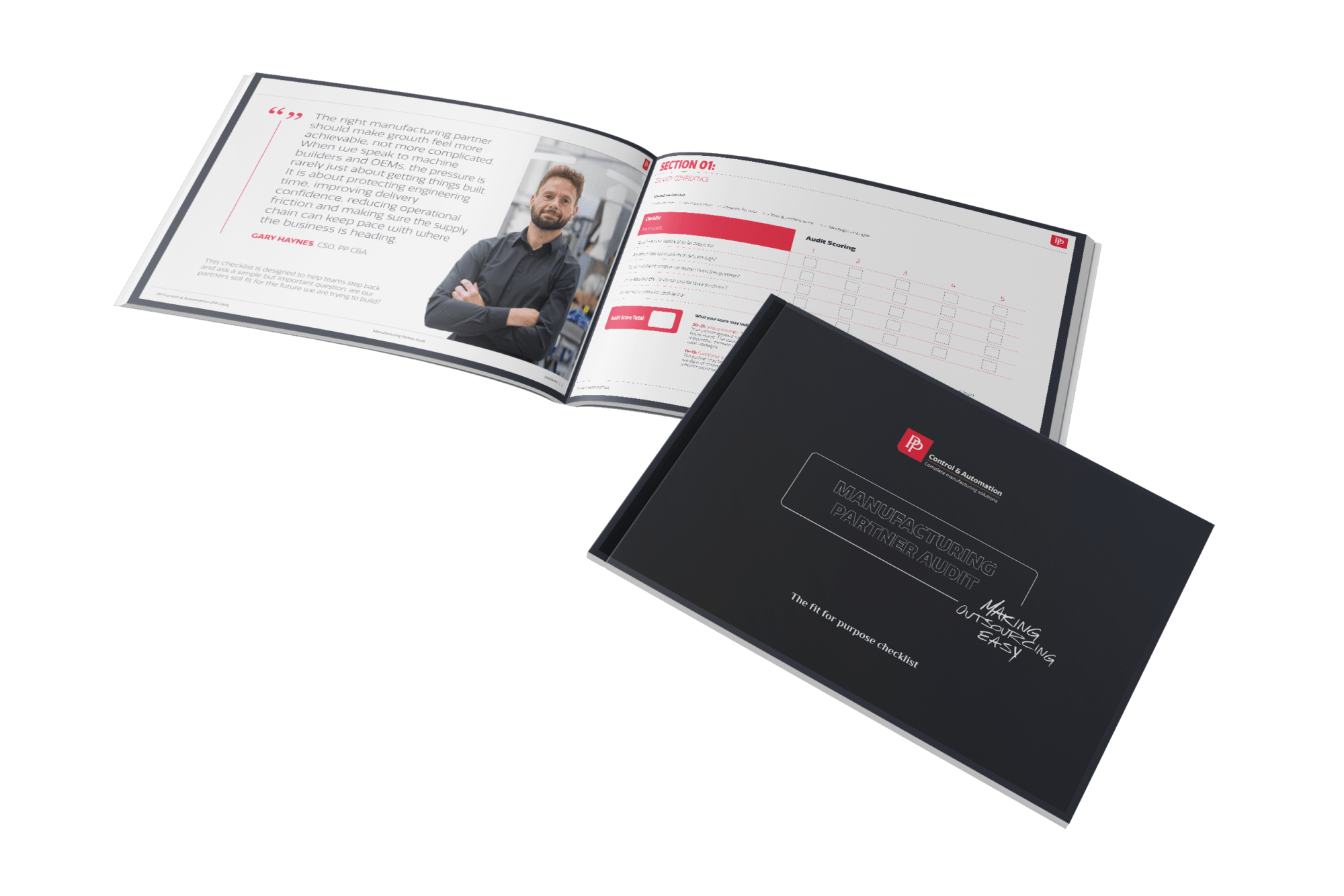
This checklist is designed to help machine builders and OEMs review whether their current manufacturing partners are supporting future growth, or creating hidden friction across engineering, procurement, operations and customer delivery.
Your supplier base plays a critical role in how well your business can scale, respond and deliver.
Use it as a practical discussion tool with your leadership, procurement, engineering and operations teams.
Very rarely does growth not surface because an OEM lacks ambition. Shortcomings arise because operating models built to support such ambition don’t evolve quickly enough.
For machine builders and OEMs, manufacturing partners play a critical role in that equation. They influence delivery performance, quality, responsiveness, engineering workload, supply chain resilience and customer confidence. Yet many supplier relationships are allowed to continue long after they have stopped adding the right level of value.
That doesn’t always mean the supplier is doing a bad job. In many cases, they were the right partner for an earlier stage of the business. Maybe they supported prototype builds, low-volume production, tactical purchasing needs or overflow capacity. But as customer expectations rise, programmes become more complex and growth plans accelerate, the questions asked of them change.
“Can they build this?” isn’t really the right question now. But, “Are they still the right partner for where we are going?” is.
That is where manufacturing partner audits become valuable. It gives OEMs a structured way to assess whether their supply base can come on the journey.
These five signs will help you evaluate whether they are still fit for purpose, or whether your business has outgrown them.
A supplier may be able to complete the work but still create uncertainty around the process.
That uncertainty often surfaces in familiar ways: late updates, unclear progress, reactive communication, inconsistent delivery dates or a lack of visibility when problems arise. For operations, procurement and project teams, this creates a hidden management burden. People spend time chasing information, checking status, escalating concerns and creating contingency plans.
The right manufacturing partner should provide clarity alongside capacity. They should understand the importance of communication, planning discipline, documentation, risk management and early escalation. If the customer only discovers an issue once it has already become a delivery problem, the relationship is too reactive.
For OEMs, the cost of poor visibility seeps beyond something as simple as one late order. It affects production planning, engineering focus, customer updates and internal trust in the supplier base.
One of the clearest signs of a supplier mismatch is the amount of internal effort required to keep things moving.
If your engineering, procurement, production or quality teams are constantly having to fill gaps, clarify basic requirements, recheck outputs, chase missing information or compensate for poor process discipline, the supplier may be consuming more capacity than they are creating.
This is especially important for OEMs dealing with complex assemblies, control panels, wiring, build packs, engineering changes or compliance requirements. In those environments, the quality of the partner’s process matters as much as the quality of the finished product.
A strategic manufacturing partner should reduce friction across the customer’s operation. They should make it easier to get from requirement to delivery. They should understand drawings, documentation, bills of materials, change control, testing requirements and quality expectations with enough maturity to remove pressure from internal teams.
If your people are carrying the relationship, the partnership is not doing enough work.
Many supplier relationships begin when the work is relatively straightforward. The product range is likely smaller and volumes are manageable. Customer requirements are clearer or simpler, compliance needs are limited (often by a single geography), and engineering changes are less frequent.
But then the business grows. Products become more varied, customers ask for shorter lead times, and export requirements increase. Things like documentation become more important, and supply chain risk becomes harder to absorb.
What used to be a manageable purchasing relationship becomes a more complex manufacturing challenge. This is arguably the most important sign and often where the gap becomes most apparent.
A supplier that was effective for basic build-to-print activity may not be equipped for more demanding programmes. A lack of engineering depth, systems, accreditations, production capacity, documentation discipline or supply chain capability will be barriers to the next stage of growth.
In short, the warning sign is strain. This evolves into discomfort around whether the supplier can handle what comes next.
For OEMs, this is the point where the partner conversation needs to become more strategic. The question is not whether the supplier can complete today’s order. It is whether they can support tomorrow’s operating demand.
Price will always matter. But in technical manufacturing, unit cost is only one part of the commercial picture.
A supplier that looks competitive on quote may create additional cost elsewhere: engineering rework, production delays, additional inspection, poor documentation, missed deadlines, supplier management time, quality issues or customer dissatisfaction.
This is why OEMs need to look beyond price and assess total value. A stronger manufacturing partner may help improve manufacturability, reduce handoffs, simplify supply chain coordination, strengthen compliance, improve repeatability, support testing, manage change more effectively and protect internal engineering time. These benefits may not always be visible in the first line of a quotation, but they can materially improve delivery performance and operational resilience.
The risk comes when supplier selection is driven too narrowly by purchase price. That can create the illusion of savings, whereby the reality is shifting cost and risk into other areas of the business.
A fit-for-purpose partner should be able to explain the value they create beyond the build itself. If the conversation never moves beyond cost, lead time and availability, the relationship may be too transactional for the role you now need it to play.

A manufacturing partner should be assessed not only against current performance, but against future fit.
This is particularly important when an OEM is entering new markets, developing new machines, increasing volume, targeting export growth, improving supply chain resilience or looking to outsource more strategically.
Future fit can include many things: capacity, technical capability, sector understanding, compliance knowledge, geographic reach, financial stability, quality systems, responsiveness, collaborative behaviour and willingness to invest in the relationship.
It also includes cultural fit. Do they understand your pressures? Do they behave like an extension of your team? Are they proactive when requirements change? Do they bring ideas, or simply wait for instructions? Can they support structured growth, or only respond to immediate demand?
A partner that is not aligned with your future direction may not cause obvious problems today. But over time, they can become a constraint on speed, flexibility and confidence.
Manufacturing partner audits should not be treated as a blame exercise. They are a way to bring structure to an important strategic question: is our supply base still fit for purpose?
For OEMs and machine builders, this is becoming increasingly important. Internal teams are under pressure to deliver more with limited capacity. Customers expect faster response, higher quality and greater certainty. Engineering teams are being pulled into more commercial, operational and documentation-heavy work. Supply chains remain complex. Growth requires a delivery model that can scale.
The right manufacturing partners can help create that model.
The wrong partners, or the right partners used in the wrong way, can have an adverse effect. They create hidden workload, increase risk and limit how quickly the business can respond to opportunity.
That is why the audit is worth doing before the pressure becomes unavoidable. Because by the time supplier limitations are showing up in missed deadlines, overloaded teams or customer dissatisfaction, the warning signs have usually been there for some time. If your business is preparing for what comes next, then now is the best time to review your manufacturing partners.
This checklist is designed to help machine builders and OEMs review whether their current manufacturing partners are supporting future growth, or creating hidden friction across engineering, procurement, operations and customer delivery.
Your supplier base plays a critical role in how well your business can scale, respond and deliver.
Use it as a practical discussion tool with your leadership, procurement, engineering and operations teams.
One of the UK’s leading strategic manufacturing specialists is tapping into the UK’s unprecedented investment in upgrading the electricity grid.

As Britain accelerates investment in grid infrastructure, protection and control capacity could become a critical delivery constraint.

The appointment of a new Prime Minister inevitably brings renewed debate about the direction of the UK economy and what it could mean for business.

Ian Knight, Chief Information Officer at PP Control & Automation (PP C&A) challenges the prevailing, often vague narrative around AI adoption and reframes the conversation around a more practical starting point: operational constraints.
Artificial intelligence is no longer a distant concept for manufacturers. It is already being explored across quotation, production planning, engineering, quality, supply chain and customer service functions. Yet, for many organisations, the gap between experimentation and meaningful operational impact remains difficult to close.

A leading aquaculture specialist – that is changing the way fish are vaccinated safely – has signed a major manufacturing deal.

On paper, defined discipline-specific suppliers can look organised. However, every additional supplier introduces another handoff, and every handoff creates another point where time, quality, communication and accountability can be lost.

Recent weeks have brought two important industry moments into sharp focus, concluding that demand for AI and automation is rising, but investment, skills, and long-term thinking must follow.


