


5th February 2026
High utilisation isn’t the same as high performance. That’s the rational truth. Walk through almost any manufacturing business and you’ll hear the same reassurance:
“Everyone’s flat out.”
Calendars are full. Engineers are booked weeks ahead. Production is running at maximum utilisation. On the surface, it feels like a healthy operation.
Busy. Productive. Efficient.
But we all know, these three outcomes don’t always add up to being effective. And in many cases, it’s a warning sign.
High utilisation often looks good on a spreadsheet, but it rarely tells the full story of performance. In fact, it can actively hide the very problems that limit growth.
Utilisation is a useful metric until it becomes the objective rather than the outcome.
When teams are pushed to stay constantly occupied, there’s no slack in the system. No space to absorb variation. No room to respond to change. Every unexpected event from a late component, or an engineering change, to a quality issue ripples through the operation.
The result? Firefighting replaces flow. Short-term fixes replace long-term improvement. And people confuse motion with progress. In these environments, fragility can rise instead of productivity.
What high utilisation often masks is where time really goes.
Engineers spend hours context-switching between urgent requests. Production teams wait on information, parts, or decisions. Managers fill the gaps by working longer days, approving exceptions, or personally unblocking issues.
Everyone looks busy!
Output doesn’t move proportionally. This is the illusion of busy: a system that feels stretched but delivers diminishing returns.

Growth can quickly fail when demand disappears, but it fails more because systems can’t absorb it.
In our experience working with machine builders and OEMs who find themselves in these predicaments and when utilisation is already near 100%, they report things like having no capacity left for responding to customer volatility, onboarding new programmes, or training new people. And that’s not all. Improving processes also takes a backseat and the time required to integrate new capabilities can’t be found.
Every new order adds stress over scale. Ironically, the businesses that appear most “efficient” are often the least adaptable.
The limiting factor in most engineering-led organisations isn’t labour. It’s focus.
Highly skilled people spend disproportionate time on work that:
This is where outsourcing is often misunderstood.
Outsourcing is about removing the noise. The most effective outsourcing relationships don’t replace internal capability. In fact, they protect it and create space for internal teams to properly flourish.
Magic Eye images come to mind (Remember the Magic Eye books that got everyone straining for some sort of clarity in the 90s – yes? – well), they reward a change in focus, not extra effort. Stare too hard at a stereogram and all you see is noise. Relax, and a hidden structure appears. The illusion of busy works the same way. When organisations fixate on utilisation and activity, clarity disappears. Only when focus shifts does performance come into view.

This stereogram contains a hidden word – can you see it?
You’ve probably heard something like – or indeed said something like this yourself… “If only we had more time to…”
This is about allowing for focus, and the preamble to so many constraints that OEMs share with us, and it often leads to…
When production support is handled by a partner built for repeatability, resilience, and scale, performance will rise. And that’s serious leverage.
The healthiest production environments often look… calm. Because, the system is absorbing complexity without constant escalation. There’s visible slack. There’s predictable flow. There’s time allocated for improvement, not just output.
Busy factories chase activity. High-performing factories actively ‘design’ capacity.
So it might just be time to rethink the metric… If your organisation is proud of being permanently stretched, it’s worth asking a different set of questions:
Where does our best talent actually add value?
How much time is spent enabling work rather than doing it?
Are we optimised for utilisation or for outcomes?
At PP Control & Automation, we see this pattern repeatedly. The breakthrough rarely comes from adding more people. It comes from changing where effort is applied.
The goal was never to be busy, but rather, to perform.
There’s more in our downloadable Magic Eye e-book! A throwback to the 90s that no one asked for, but why let that stop us? Find the hidden messages and images, alongside magic outsourcing stories.
This book exists for anyone who has ever looked at a full calendar, a stretched team, or a factory running flat out – and still felt that progress was somehow harder than it should be.
Add to basket
In your basket


One of the UK’s leading strategic manufacturing specialists is tapping into the UK’s unprecedented investment in upgrading the electricity grid.

As Britain accelerates investment in grid infrastructure, protection and control capacity could become a critical delivery constraint.

The appointment of a new Prime Minister inevitably brings renewed debate about the direction of the UK economy and what it could mean for business.

Ian Knight, Chief Information Officer at PP Control & Automation (PP C&A) challenges the prevailing, often vague narrative around AI adoption and reframes the conversation around a more practical starting point: operational constraints.
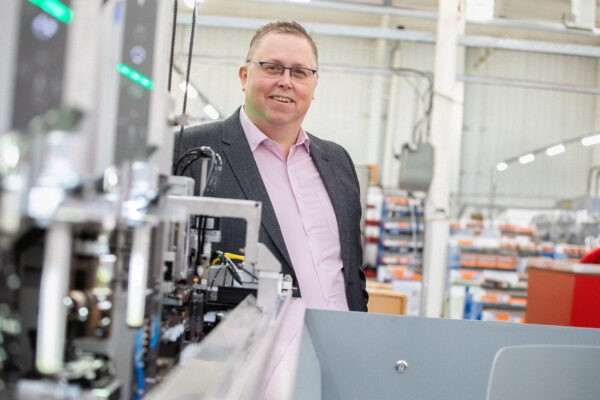
Artificial intelligence is no longer a distant concept for manufacturers. It is already being explored across quotation, production planning, engineering, quality, supply chain and customer service functions. Yet, for many organisations, the gap between experimentation and meaningful operational impact remains difficult to close.

A leading aquaculture specialist – that is changing the way fish are vaccinated safely – has signed a major manufacturing deal.

On paper, defined discipline-specific suppliers can look organised. However, every additional supplier introduces another handoff, and every handoff creates another point where time, quality, communication and accountability can be lost.

Very rarely does growth not surface because an OEM lacks ambition. Shortcomings arise because operating models built to support such ambition don’t evolve quickly enough.


